
Tree care in Medford starts with a health check: a trained person walks around the tree, looks at the roots, trunk and crown, and tells you whether it is sound, needs work, or should come out. Ask for an ISA Certified Arborist for this. Call (541) 855-3179 to be connected with an independent local tree service.
Tree Services Medford is a referral service. It does not inspect trees, give tree advice on site or employ arborists. Your call goes to an independent Medford-area tree service that holds an active Oregon CCB license, and that company tells you who will do the check and what it costs. This page explains what a check covers, which credentials to ask about, the tree problems that show up in valley yards, and how to protect a tree during building work. All the other services are on the home page.
What a tree health check covers
A basic check is a visual inspection from the ground, sometimes with simple tools. The person doing it should look at the whole tree and the site around it, then explain what they found in plain terms.
A thorough check usually includes:
- The root zone. Soil heaving, cut or damaged roots, fill dirt piled over roots, and mushrooms at the base.
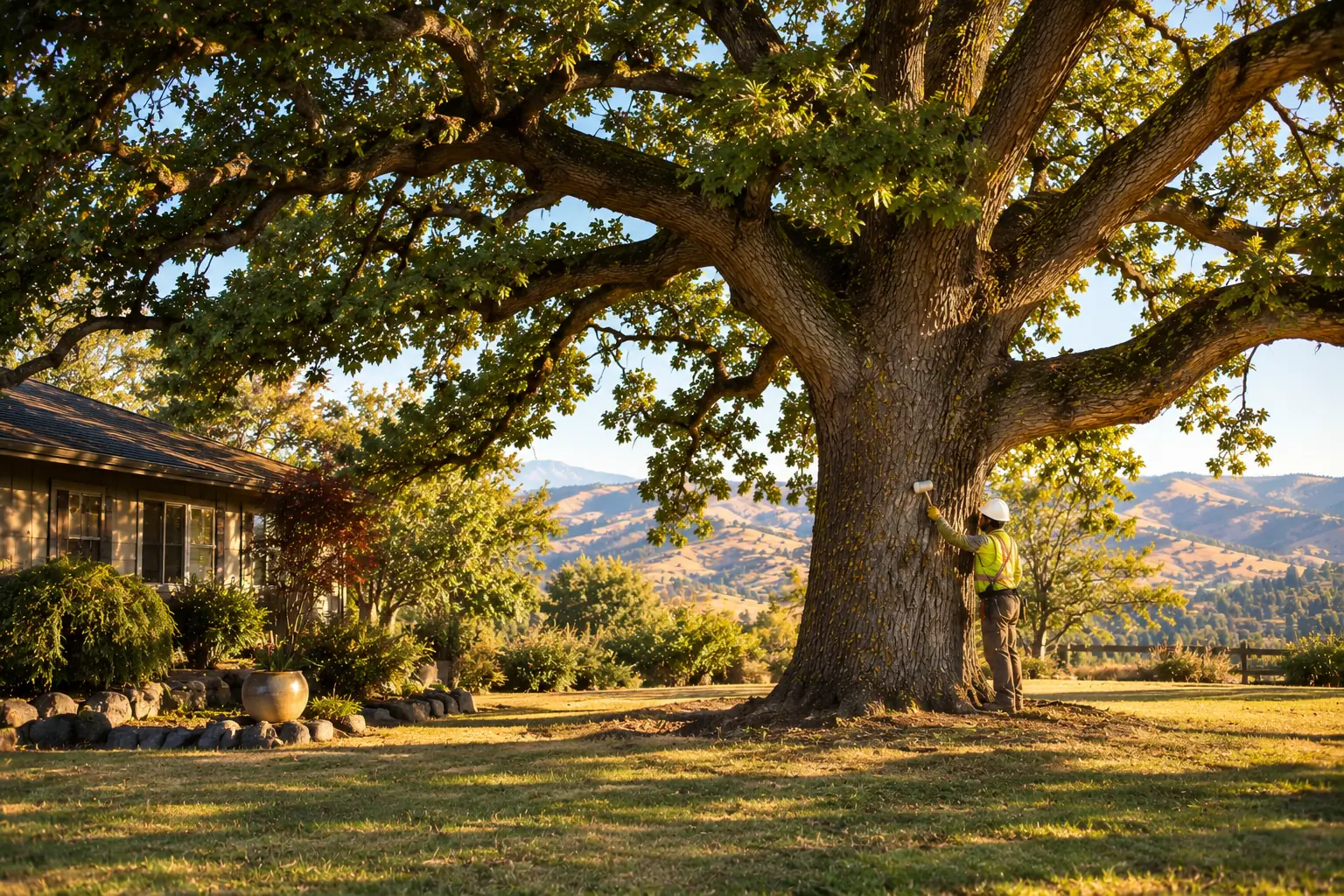
- The root flare and trunk. Cracks, cavities, loose bark, oozing, and old wounds. Some inspectors tap the trunk with a mallet and listen for hollow sounds.
- The main branch unions. Tight forks with bark pressed in between, which can split.
- The crown. Dead branches, thin or off-color leaves, dieback at the tips, and broken limbs.
- Targets. What the tree would hit if part of it failed: the house, a driveway, a play area, a neighbor's yard.
You should come away with a short list: work to do now, work that can wait, and anything to watch. If you need the findings for a city, an insurer or a neighbor, ask for them in writing.
What an arborist is and which credentials to ask about
An arborist is a person trained in the care of individual trees. Anyone can use the word, so credentials are what let you check.
| Credential | Who issues it | What it tells you |
|---|---|---|
| ISA Certified Arborist | International Society of Arboriculture | The person passed an exam on tree care and keeps up continuing education |
| Tree Risk Assessment Qualification (TRAQ) | International Society of Arboriculture | The person trained in formal tree risk assessment and must retrain every seven years |
| Oregon LCB license, arborist phase | Oregon Landscape Contractors Board | A license phase created for ISA Certified Arborists covering tree work |
| Oregon CCB license | Oregon Construction Contractors Board | The business is licensed as a contractor in Oregon |
The International Society of Arboriculture says TRAQ holders must retrain and retest every seven years, and that candidates need a recognized credential first, such as Certified Arborist (ISA, TRAQ). ISA's consumer site describes certification as voluntary and says certified arborists must continue their education to keep it (ISA, why hire an arborist). You can look up a certified arborist through ISA's search tool.
The Oregon Landscape Contractors Board notes that all tree work may be done under an LCB license, and that removal and stump grinding may also be done under a CCB license (Oregon LCB, tree work FAQ). Ask the company which licenses and certifications the person doing your check holds, then confirm them. CCB numbers can be checked at the CCB license search.
Tree problems seen in Rogue Valley yards
A few problems come up again and again around Medford. Naming them helps you describe what you see when you call.
| What you notice | Possible cause | What a tree service may suggest |
|---|---|---|
| Round green clumps in an oak's crown, easiest to spot after leaf fall | Oak mistletoe | Pruning out infected branches where practical |
| Small blobs of pitch on the bark of a pine, a fading crown | Bark beetles, often in stressed trees | Inspection, and removal of infested trees |
| Branch tips on a pear or apple that blacken and curl like a shepherd's crook | Fire blight | Cutting out infected wood with clean tools |
| Dieback after a new driveway, trench or addition | Root damage from construction | Watering, mulching, and pruning dead wood |
| Mushrooms or shelf fungus at the base | Root or trunk decay | A closer look at the base, sometimes a risk assessment |
The Pacific Northwest plant disease handbook says oak mistletoe affects Oregon white oak, that heavily infected trees grow more slowly and are more prone to insect attack and drought death, and that heavily loaded branches can break in storms (PNW Plant Disease Management Handbook, oak mistletoe). It notes that cutting off only the visible shoots lets them grow back.
The Oregon Department of Forestry lists ponderosa pine as the main host of the western pine beetle and shows pitch tubes as a sign of attack (ODF forest health fact sheet, western pine beetle, March 2017). Oregon State University's fire blight guidance says to sterilize pruning tools between cuts in spring and summer, to cut 12 to 15 inches below infected wood at that time of year, and to avoid pruning when trees are wet (OSU Extension, fire blight).
For help naming a pest or disease before you hire anyone, the OSU Extension office in Jackson County runs a Master Gardener plant clinic at the Southern Oregon Research and Extension Center in Central Point.
Protecting a tree during building work
Many tree deaths in town start with a construction project, not a storm. Roots spread far past the trunk and sit close to the surface, so a new patio or trench can cut off a large share of them.
Medford's tree protection guideline, updated April 2026, gives a way to size the area to protect (City of Medford tree protection guidelines):
- Measure the trunk diameter in inches about 4 to 4.5 feet above the ground.
- Multiply that number by 18. The answer, in inches, is the radius of the critical root zone. A 10 inch trunk gives a 15 foot radius.
- Put metal construction fencing around that zone before work starts and keep it up until the project is finished.
- Keep grade changes, parked equipment, stored materials and spilled fuel out of the zone.
- Water at about one inch a week over the undisturbed zone during construction.
The guideline says that when construction affects more than 30 percent of the critical root zone, the tree is considered damaged beyond probable recovery. It also recommends a project arborist certified by the International Society of Arboriculture. The guideline is advice for private property, not a requirement, but it is the city's own yardstick.
Care services and what they cost
After a check, the company may suggest work beyond pruning. LawnStarter's national figures, updated October 9, 2026, give these ranges (LawnStarter, arborist cost):
- Consultation or inspection: free to $250.
- A written arborist report on tree health with treatment advice: $250 to $400.
- Hourly rate for consultation and estimates: $75 to $250.
- Tree injections of fungicide or insecticide: $60 to $250 per tree.
- Deep root fertilization: $100 to $300 per tree or shrub.
- Cabling to support weak branches: $150 to $450.
These are national ranges, not Medford quotes. The written estimate from the company that sees your tree is what counts. Ask whether a fee for the check is credited toward any work you book. The tree service cost guide covers pricing for trimming and removal.
Questions for the person checking your tree
Good questions turn a quick look into useful advice:
- Are you an ISA Certified Arborist, and do you hold TRAQ?
- What is the biggest risk you see in this tree, and how soon should it be handled?
- Can the tree be kept with pruning, or does it need removal?
- Will you put your findings in writing?
- If you recommend a treatment, what product is it and why?
- When should someone look at this tree again?
Frequently asked questions
How do I know if my tree is dying?
Common signs are dead branches spreading through the crown, leaves that come out late, small or yellow, bark falling away, and fungus at the base. One sign alone does not always mean the tree is dying. A health check can tell you how serious it is.
Is a free estimate the same as a health check?
Not always. A free estimate is often a price for work the homeowner asked for. A health check looks at the whole tree and may come with a fee. Ask the company which one you are getting.
Does Medford have rules for old or large trees?
The city runs a heritage tree program and has an application for it on the Parks Department's tree page. Street trees in the public right of way need a free permit for pruning or removal. The Medford tree rules guide has the details.
Can a tree with mistletoe be saved?
Often, if the infection is limited. Pruning out infected branches removes the mistletoe at the source, while cutting only the visible clumps lets it regrow. A heavily infected oak may need more work, so ask for an inspection.
Should I fertilize a stressed tree?
Not without a reason. Fertilizer will not fix root damage, drought or disease, and the wrong product can do harm. Ask the person checking the tree to explain why a treatment is needed before you pay for it.